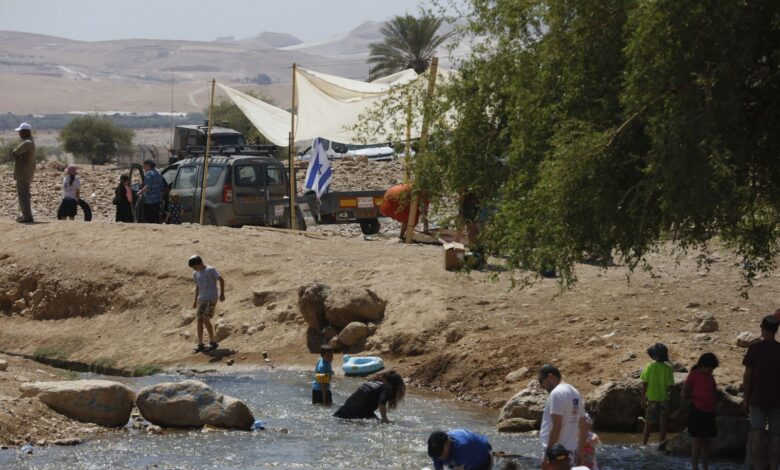
Jordan Valley (UNA/WAFA) – Overnight, residents of the pastoral and agricultural communities in the Al-Auja area in the Jordan Valley found themselves in their most difficult situation in years, after their most important spring, which constitutes the main lifeline in the region, dried up.
This year's spring drying up, which occurred very early, before the peak of summer, has serious causes, including a weak rainy season and a lack of rainfall to replenish groundwater supplies, in addition to the encroachments of the Israeli occupation and settlers on water resources.
Farhan Ghwanmeh, a resident of the Al-Auja Spring for many years and a livelihood from livestock, told WAFA: “This year is one of the harshest and most difficult years for the pastoral communities in the region, which rely heavily on the waters of the Al-Auja Spring, which constitutes a vital lifeline.”
Ghawanmeh believes that several factors have conspired this year against the residents of the region's pastoral communities. The weak rainy season, which has led to the drying up of the spring, has been an additional factor in their suffering. He asserts that the Bedouin communities have also been suffering for years from practices by the occupation authorities and settlers aimed at displacing them from the region.
Among the most significant challenges facing these communities is the policy of depriving them of water, pursued by the occupation forces in cooperation with the settlers, who have spared no effort over the years to persecute the communities' residents and shepherds and deprive them of their pastures. They have also employed numerous methods to deprive them of water sources, the most important of which for them is the water source of Al-Auja, the lifeblood of the region's citizens' resilience.
“This year, we were caught between two fires: the lack of rain on one hand, and the occupation’s encroachments on the other,” Ghwanmeh adds. Like other residents of the region, he believes that the drying up of the spring was not solely a result of climatic factors, but also of colonial schemes in the region, which began many years ago with the occupation authorities’ drilling of deep groundwater wells that pump huge quantities of water for the benefit of the settlements and deplete the groundwater reservoir.
In addition to the occupation authorities' depletion of the groundwater supply, the settlers continue this role by denying farmers access to the remaining surface water. They carry out daily attacks on farmers as they head to water sources, and they pursue water tankers, cutting the plastic pipelines used by residents to draw water, and connecting these pipelines to their pumps, according to Ghawanmeh.
In this context, data from the Central Bureau of Statistics and the Palestinian Water Authority indicate that Palestinian citizens' water consumption rates are low, falling below the internationally recommended rate. "In 2022, the average daily Palestinian consumption rate reached 85.7 liters of water. When taking into account the high rate of water pollution in the Gaza Strip and calculating the quantities of water suitable for human use from the available quantities, the per capita share of fresh water will fall to only 20.5 liters per day."
The same data also reveals a significant disparity between the per capita consumption rates of Palestinians and Israelis. "It is noted that the per capita consumption rate of Israelis is three times that of the Palestinian population, with the per capita consumption of Israelis reaching approximately 300 liters per day. This rate doubles for Israeli settlers, reaching more than seven times the per capita consumption of Palestinians."
Ashraf Barakat, director of the Jericho and Jordan Valley Agriculture Directorate, explained to WAFA that the Auja Spring has been suffering from a steady decline in water levels for seven years due to the excessive pumping of water by Israeli settlements into the area. This has directly threatened the Bedouin presence and Palestinian communities in the area.
Barakat points out that the occupation's encroachments on water in the area include the presence of water pumps that draw water for the settlements, in addition to deep artesian wells that were dug to supply the settlements.
He explains that the weak rainfall this year has exacerbated the crisis. Rainfall was sporadic and stopped early, causing the spring to fall to its lowest levels in seven years. Typically, during seasons with scant rainfall, the spring would reach this stage of drought in July, the height of summer, rather than in April or May, as happened this year.
Barakat believes that "this drought is not only a natural drought, but is also the result of factors linked to the occupation, the most important of which is the excessive pumping of water."
Data available to the Directorate of Agriculture in Jericho indicate that the Auja Spring is of great importance to many pastoral communities whose existence is based primarily on it. Communities such as Al-Shalal, Al-Najada Al-Fuqa, Al-Najada Al-Tahta, Al-Kaaba, Al-Suwaidat, Al-Jarahid, Al-Sa'aida, Al-Atiyat, and Al-Rummanin live in the vicinity of the spring. These communities include approximately 140 families. Approximately 13 heads of livestock also benefit from the spring. In terms of vegetation, approximately 8 dunums of agricultural land depend on the Auja Spring, including lands planted with vegetables, palm trees, and bananas.
Water expert Sayel Washahi explains that the Auja Spring is unique; it is one of Palestine's most historic springs. It has been used historically, and is surrounded by population centers, pastoral life, and agricultural life.
He adds that the Auja Spring is geologically classified as a karst spring, resulting from caverns within rocks. Flow rates in these springs are high and rapid at the onset of the rainy season, and then decline rapidly as a result. In other words, the water flow in the Auja Spring increases annually with the onset of winter, then gradually declines as the summer progresses.
He noted that the Auja spring pumps an average of 1200-1500 cubic meters per hour, and sometimes the pumping rate reaches 2000 cubic meters per hour in good seasons depending on the rainfall rate. In some years, it dries up or the water remains confined only to the head of the spring, without reaching the stream. He emphasized that the pumping quantities, depending on the current drought, range between 200-300 cubic meters per hour, and may reach complete dryness later.
Washahi points out that the significant decline in spring water this year is directly linked to the decline in rainfall. In some areas, rainfall did not reach even 50% of the average rainfall season, which has affected the head of the spring and its main flow.
Regarding the role of settler encroachments in depriving residents of Palestinian communities that depend on the spring, Washahi asserts that these encroachments, particularly in recent times, have a significant impact on the water flowing from the spring through the valleys, preventing it from reaching citizens. The settlers are diverting the water to serve them and diverting it from the main stream that reaches residential and agricultural communities.
All of this places citizens, particularly farmers and livestock breeders, in difficult living conditions. Drought, coupled with frequent encroachments, has raised the cost of subsistence and access to water.
In the same context, water and settlement issues researcher Walid Abu Mohsen points out that the Auja Spring and other springs in the Palestinian Jordan Valley fall within the Eastern Water Basin, which lies largely within the West Bank. Under the Oslo Accords, the Palestinians' annual water share amounts to 118 million cubic meters, half of which is obtained from the Eastern Basin alone.
He added that although the agreements stipulated the Palestinians' water shares, they do not receive these full shares, and their access to water declines year after year. They are deprived of water resources and the quantities available to them decrease, either due to settlers' encroachments on water resources, such as seizing springs, stealing the flow of water, or diverting it, or due to the policies of the occupation authorities. He pointed out that in the eastern basin region, there are 42 Israeli wells that pump approximately 50 million cubic meters of water annually. These wells lead to the depletion of the groundwater reservoir in the region and affect the Palestinians' ability to obtain the quantities of water they need.
The occupation's deep-drilled wells are contributing to the depletion of the groundwater reservoir in the Jordan Valley. Over the years of occupation, this has led to a significant percentage of Palestinian wells drying up, and to the water level in the springs on which residents depend drying up or decreasing. This has deprived residents of their full share of water stipulated in the agreements, as the remaining water sources do not cover their needs, whether for daily and personal purposes or for agricultural and pastoral needs, which constitute the lifeblood of the Jordan Valley, Abu Mohsen explains.
Regarding the drying up of the Auja Spring this year, Abu Mohsen referred to the climate factor, as the weak rainfall season has left the groundwater aquifer insufficiently replenished with water.
He also touched on the significant role of the occupation's practices in the region, including the massive amounts of water pumped from Israeli wells, emphasizing that the spring's drying up occurred early in the year, before the peak of summer. This, he said, points to the crucial role of the occupation's violations and practices in this regard.
He points out that the occupation's attacks on water resources in the Jordan Valley and the eastern basin areas are divided into two parts: the attacks of the occupation authorities represented by the large number of deep Israeli wells that lead to the depletion of the groundwater reserve and the transfer of the greatest benefit from it to the settlements, and the attacks of the settlers represented by the seizure of surface water resources and depriving citizens of access to them; this is done by placing water traps and diverting its natural course, as is happening in the Al-Auja Spring area, in addition to the backfilling, destruction, seizure and fencing operations that they carry out.
A previous study by researcher Tayseer Jabara on the occupation's control over water resources in Palestine explained that "the occupation authorities seized vast areas of Palestinian land, controlling the most important water resources therein under the pretext of preserving natural areas. The real goal was to exploit water resources to irrigate lands seized by Palestinian settlers and on which settlements were established, until approximately 90% of the West Bank's springs came under the control of the occupation, which exploits them according to its needs."
The study continued: “The occupation authorities focused on controlling groundwater by not granting any licenses to dig new artesian wells or deepen artesian wells that were dug before 1967. They also limited the quantities of water that could be extracted from these wells by installing a meter on each well for monitoring. The occupation authorities also prevented most municipalities and local authorities from digging the necessary wells for drinking purposes, while allowing settlers to exploit groundwater in the West Bank and Gaza Strip to irrigate their crops.”
The study also addressed the Al-Auja area, which was rich in water resources, as an example of the water crisis in the West Bank. It noted: “We see that the Al-Auja area near Jericho has suffered since 1985, as farmers relied on the Al-Auja springs to irrigate their crops, which provided them with 17 million cubic meters annually, in addition to a number of artesian wells. However, the resort of neighboring settlements to dig deep wells in the area led to the drying up of the Al-Auja springs on the one hand, and the depletion of the water of the Arab artesian wells on the other, until they became unusable due to their salinity…”
The study adds: "As for the settlements surrounding Jericho, they were allowed to dig deeper wells in the quantities required by the settlers. Due to the lack of sources for irrigating Palestinian crops, the farmers of Al-Auja were forced to destroy 90% of their fruit trees, and 50% of the remaining trees were destroyed in 1987. Hundreds of dunams of vegetable crops were also destroyed."
The Palestinian Environment Quality Authority documented a series of systematic Israeli violations against the Palestinian environment during the first quarter of this year. These violations included the destruction of water resources, the vandalism of agricultural land and trees, the pumping of wastewater, attacks on livestock, and the smuggling of solid and hazardous waste into Palestinian territory.
The report issued by the Environmental Quality Authority monitored dozens of attacks in various northern governorates, with 15 attacks on water wells recorded, including the destruction and filling of wells in Jenin, Tubas, the northern Jordan Valley, Hebron, Jericho, Qalqilya, and Nablus. Four attacks targeted water networks in Jenin and its refugee camp, Khallet al-Dabaa in Masafer Yatta, and the Fasayil area north of Jericho.
The report also documented eight incidents involving the use of untreated wastewater. Israeli settlements pumped large quantities of wastewater into Palestinian agricultural lands in Qalqilya, Jericho, Bethlehem, and Hebron, polluting vast areas and destroying agricultural crops.
The Environment Quality Authority confirmed in its report that these Israeli practices and attacks constitute a flagrant violation of international environmental laws and agreements, most notably the Basel Convention and the Convention on Biological Diversity.
It is noteworthy that the Palestinian Jordan Valley extends along the eastern borders of the West Bank, for a distance estimated at 120 km and a width ranging between (5-20 km) depending on the proximity or distance of the mountain ranges from the Jordan River. Thus, it constitutes 28% of the area of the West Bank, with an area estimated at about 1600 square kilometers, and more than 65 thousand Palestinian citizens live there.
(is over)