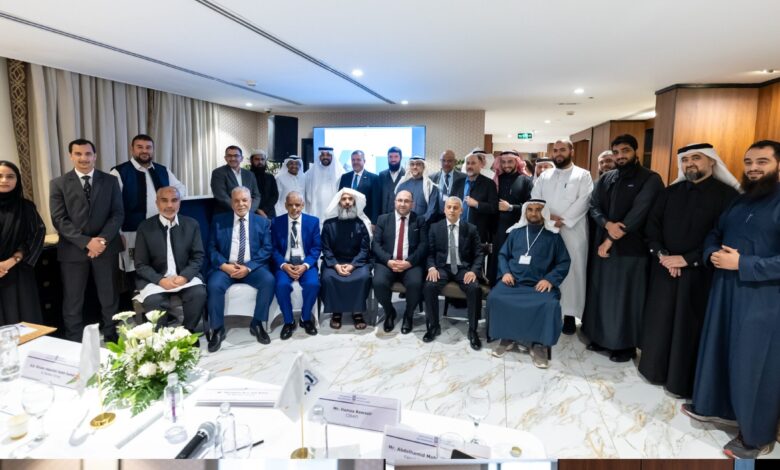
Madinah (UNA) – The General Council for Islamic Banks and Financial Institutions, the official umbrella for the global Islamic finance industry, successfully held its third strategic meeting on the Islamic economy, entitled: “Towards Activating Participation-Based Investment Accounts: A Regulatory and Applied Reading of the Islamic Banking Model,” in person in Madinah and remotely, in conjunction with the Al Baraka Symposium, with high-level participation from industry leaders and decision-makers.
This meeting builds upon the remarkable success of previous editions, bringing together board members, senior executives, regulatory representatives, academics, and stakeholders in a high-level dialogue platform to discuss the most important developments and challenges facing the Islamic finance industry, and to produce fruitful recommendations that contribute to enhancing the industry's growth and sustainability. This year's theme focused on investment models based on participation and promoting the concepts of sustainable risk-sharing as a fundamental pillar of Islamic banking.
The meeting opened with a speech by Sheikh Abdullah Saleh Kamel, Chairman of the Board of Directors of Al Baraka Group and the General Council, who emphasized that this strategic gathering represents a pivotal moment in the development of Islamic banking. He stated that it reflects a collective commitment from industry leaders to return to the core principles of partnership and genuine investment as a fundamental pillar of growth and sustainability. He explained that the rapid transformations occurring within the Islamic finance industry, coupled with its accompanying regulatory and competitive complexities, necessitate strengthening governance, transparency, and accountability in investment accounts. This will ensure the protection of stakeholders' rights, foster long-term trust, and bolster the sector's resilience in the face of future challenges.
In the same vein, Professor Hamza Bawazir, Secretary General of the General Council, welcomed the participants, announcing the official launch of the General Council’s Strategic Plan for the period 2026–2029. This plan focuses on strengthening the regulatory and supervisory frameworks supporting Islamic banking, enhancing corporate governance, building human and knowledge capacities, deepening international partnerships, and expanding the General Council’s global influence. In this context, he stated, “Partnership-based investment accounts represent the core of the added value offered by Islamic banking and are central to its contribution to building a more equitable and sustainable financial system. Reactivating these instruments is a strategic necessity to restore the concept of genuine risk-sharing, enhance depositor confidence, and solidify the developmental role of Islamic banks. This meeting provides a valuable platform to address regulatory and operational challenges and promote innovative, Sharia-compliant solutions.”
The first session addressed the most prominent regulatory, accounting and operational constraints that affect the effective investment role of these accounts, in addition to the challenges associated with adapting them to modern banking requirements while maintaining their investment nature, with the participation of Dr. Ibrahim Al-Otaibi, Director of Product Development Department in the Sharia Sector, Alinma Bank, Kingdom of Saudi Arabia; Dr. Khalid Al-Sayari, Associate Professor at the College of Humanities, Saudi Electronic University, Kingdom of Saudi Arabia; and Dr. Talal bin Sulaiman Al-Dossari, Professor of Comparative Jurisprudence, Qassim University, Kingdom of Saudi Arabia.
During the second session, the focus was on institutional methods to enhance governance, consolidate the principles of risk sharing, and improve transparency and stakeholder confidence, through a diverse group of experts, namely Professor Iyad Al-Asali, General Manager of the Arab Islamic International Bank in Jordan; Dr. Abdulbari Mashal, Managing Partner, Supervision, USA; and Dr. Mohamed Talal Lahlu, Certified Sharia Consultant and Auditor and President of the Moroccan Association for Islamic Economics, Rabat Branch.
The practical priorities and future applied workshops were highlighted, with emphasis placed on the importance of gradual reforms to ensure stronger alignment between regulatory frameworks and Sharia-based investment principles by Professor Al-Hadi Al-Nahawi, Sharia Compliance Transactions Officer, Islamic Development Bank, Kingdom of Saudi Arabia; Dr. Faisal Al-Atbani, Consultant in Islamic Finance, Kingdom of Saudi Arabia; and Professor Mohammed Abdullah Al Abdulrahim, Academic and Consultant in Islamic Banking and Financial Technology, Kingdom of Saudi Arabia.
The meeting concluded with an open interactive discussion that reflected a broad consensus among the participants on reviving and developing partnership-based investment models, thereby enhancing the competitiveness and sustainability of Islamic banking at the regional and global levels.
(is over)