Geneva (UNA/WAFA) – The International Labour Organization held an international donors’ meeting yesterday, Tuesday, with the aim of mobilizing financial and technical support for the Decent Work and Recovery Programme and promoting employment and social protection in the occupied Palestinian territory, in order to support recovery efforts, restore livelihoods, provide decent work opportunities and strengthen the social protection system.
The meeting follows a decision by the Governing Body of the International Labour Organization, during its 355th session, and is part of strengthening coordinated international support for the Decent Work and Recovery Programme in the Occupied Palestinian Territory for the period 2026–2029, which constitutes the regulatory framework for the organization’s interventions in the West Bank, including East Jerusalem, and the Gaza Strip.
The meeting was convened at the joint invitation of the Director-General of the International Labour Organization, Gilbert Houngbo, the State of Qatar and the Kingdom of the Netherlands, in cooperation with the Palestinian side, represented by the State of Palestine’s mission to the United Nations in Geneva, the Ministry of Labour and representatives of workers and employers.
The discussions focused on the need to link the response to urgent humanitarian needs with the requirements of economic recovery and development, employment, workers’ rights and social protection at the heart of reconstruction efforts, in order to ensure the sustainability of interventions and enhance the Palestinian economy’s ability to recover.
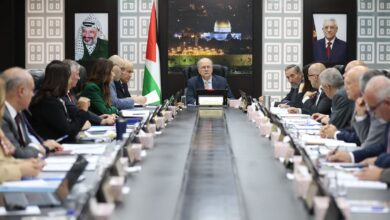
The meeting opened with remarks from the Director-General of the International Labour Organization, Qatari Minister of Labour Ali bin Saeed Al-Marri, Permanent Representative of the Kingdom of the Netherlands Erika Schouten, and Egyptian Minister of Labour Hassan Al-Raddad, in the presence of the Permanent Representative of the State of Palestine to the United Nations, Ambassador Ibrahim Khraishi.
In her address via video conference, Minister of Labor Inas Al-Atari thanked the organization, the countries, and all parties for their efforts, and stressed the need to translate international support into tangible employment programs that respond to national needs. She reviewed the national strategic pillars of employment, which include entrepreneurship, the cooperative economy, vocational training, and emergency employment. She emphasized the importance of supporting the Palestinian Employment Fund and enhancing its capacity to provide job opportunities and contribute to the recovery of economic activity.
For his part, the Secretary-General of the General Federation of Palestinian Trade Unions, Shaher Saad, emphasized the importance of supporting the Palestinian people through effective recovery and employment programs. He commended the role of the International Labour Organization, the State of Qatar, and the Kingdom of the Netherlands in convening this meeting. He stressed that achieving social justice is contingent upon ending the occupation, establishing the State of Palestine, and realizing the rights of the Palestinian people.
For his part, Abdo Idris, head of the Federation of Palestinian Chambers of Commerce, Industry, and Agriculture, stressed the need to move from responding to emergency needs to adopting a sustainable economic vision that supports the private sector and Palestinian businesses, and promotes decent work and social protection. He called for supporting the Palestinian Employment Fund and expanding partnerships between governments, workers, and employers, which would contribute to protecting workers and restoring economic activity.
The meeting witnessed extensive interventions from the participating countries, which generally affirmed their support for the Palestinian people and the need to provide sustainable and coordinated funding for recovery and reconstruction efforts. They also expressed their support for the ILO program and stressed the importance of integrating employment, decent work, and social protection into recovery efforts from their earliest stages.
Among the most notable contributions was Italy's announcement of €5 million over three years and Kuwait's reaffirmation of its continued annual contribution of half a million dollars. Participating countries, including Kuwait, Jordan, Algeria, Oman, the UAE, Iraq, Libya, Italy, Indonesia, Spain, France, Brazil, Kenya, Turkey, and the European Union, emphasized the importance of supporting the resilience of the Palestinian people and their national institutions, and bolstering recovery and reconstruction efforts through sustainable, multi-year funding. They stressed the need to link humanitarian response with economic development, protect livelihoods, create job opportunities, enhance social protection and vocational training, and develop Palestinian institutions, with a focus on the economic empowerment of women, youth, and persons with disabilities. Representatives of the international trade union movement and employers also underscored the necessity of restoring the productive capacity of the Palestinian economy and ensuring the participation of workers and employers in setting recovery priorities.
(is over)