

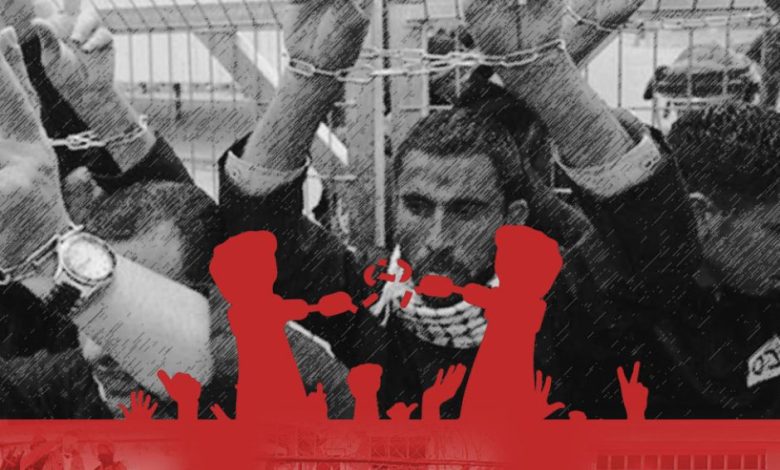
Ramallah (UNA/WAFA) - The Palestinian people in the homeland and diaspora commemorate Palestinian Prisoners' Day on April 1974th of each year. The Palestinian National Council adopted it in XNUMX as a national day for the freedom of prisoners, to unify efforts and activities to support them, and to uphold their legitimate right to freedom.
Since that date, Prisoners' Day has been and continues to be an immortal day commemorated annually by the Palestinian people in all places of their presence, both in the homeland and in the diaspora, through various means and forms. This day serves to remind the entire world of Palestinian prisoners and the horrific forms of torture and violations they are subjected to on a daily basis in the occupation's prisons, which violate all international and humanitarian norms and covenants, foremost among which are international humanitarian law, the Fourth Geneva Convention, human rights principles, and the Statute of the International Criminal Court.
This date was chosen to commemorate Prisoners' Day, as it marked the release of the first Palestinian prisoner, Mahmoud Bakr Hijazi, in the first prisoner exchange between the Palestinians and the Israeli occupation.
The 2008th Arab Summit, held in late March XNUMX in the Syrian capital, Damascus, decided to mark this day annually in all Arab countries, in solidarity with Palestinian and Arab prisoners in Israeli prisons.
The prisoners’ institutions said that at least (63) detainees were martyred in the Israeli occupation prisons since the beginning of the aggression on the Gaza Strip, including (40) martyrs from Gaza, while the occupation continues to conceal the identities of dozens of martyrs and detain their bodies, noting that the number of martyr prisoners whose names have been documented since 1967 is (300) martyrs, the last of whom was the child Walid Ahmed from Silwad.
In a joint statement marking Palestinian Prisoners' Day, the organizations added that torture crimes at all levels, as well as starvation, medical crimes, and sexual assaults, including rape, were the primary causes of the deaths of prisoners and detainees at a higher rate than in any other period, based on historical monitoring and documentation available to institutions.
The prisoners' institutions pointed out that the testimonies and statements of prisoners inside the occupation prisons, which were transmitted by legal teams, and the testimonies that were documented from those released, gained a shocking and horrific level of systematic torture methods, specifically in the accounts of detainees from Gaza. These testimonies included, in addition to the torture operations, unprecedented methods of humiliation to violate human dignity, severe and repeated beatings, and deprivation of the minimum necessary conditions of life in detention. We find that the occupation has worked to institutionalize crimes using specific tools and methods, which require the international human rights system to view it as a new phase that threatens all of humanity, not just the Palestinians. This also applies to the issue of Palestinian prisoners and detainees.
She pointed out that the far-right occupation government has escalated its incitement campaigns and targeting of prisoners since before the war of extermination, as it was clear that it was in the context of escalating its crimes against detainees through repression and its attempt to deprive them of what remains of their rights. The stage that preceded the extermination was a prelude to its intentions that called for their execution through its extremist minister (Ben Gvir), who represented the entire occupation system, which worked to incite prisoners to kill them and shoot them in the head to solve the problem of overcrowding in prisons.
The number of arrests since the beginning of the genocide has reached (16400), including more than (510) women and about (1300) children. This data does not include the arrests from Gaza, which are estimated in the thousands, including women and children, as the crime of enforced disappearance was the most prominent crime practiced by the occupation against the detainees of Gaza and continues to be.
The occupation worked to create special camps to detain detainees from Gaza and the West Bank, as the number of detainees increased, in addition to the central prisons. The most prominent of these was the (Sde Teiman) camp, which was the most prominent location for torture crimes, and the (Rakefet) prison, in addition to the (Anatot) camp, the (Ofer) camp, the (Naftali) camp, and the (Menashe) camp, which are camps affiliated with the administration of the occupation army. These are the only camps that institutions were able to monitor, and there may be secret prisons and camps. The occupying state used a number of tools to entrench the crime of enforced disappearance, by adapting the law by imposing amendments to the so-called (unlawful combatant) law, as well as preventing the International Committee of the Red Cross from visiting them, and not disclosing their numbers, places of detention, conditions of their detention, or anything related to their fate. The occupation deliberately treated them as numbers. Later, in light of the amendments that were made, legal teams were able to reveal the fate of thousands of detainees from Gaza.
The number of detainees in the occupation prisons is more than 9900 detainees, and this data does not include all the detainees from Gaza who are subject to the crime of (enforced disappearance). The number of female prisoners is (29), including a female prisoner from Gaza and a child, while the number of child prisoners (cubs) under the age of (18 years) is about (400) children distributed among the prisons (Megiddo, Ofer).
The number of administrative detainees reached more than (3498) administrative detainees (until the beginning of April), including (4) women and more than (100) children. The majority of administrative detainees are former prisoners who spent years in the occupation’s prisons, in addition to other categories that included: school and university students, journalists, human rights activists, lawyers, engineers, doctors, academics, representatives, activists, workers, and first-degree relatives of martyrs and prisoners in the occupation’s prisons, including sisters of martyrs and wives of prisoners.
The number of detainees classified by the occupation as “illegal combatants” according to the Prison Administration’s data is (1747), and this data is up to the beginning of April 2025.
The issue of administrative detainees represented the most prominent transformation, alongside the series of systematic crimes carried out by the occupation since the beginning of the war of extermination. The number of administrative detainees has risen to the highest in history, as the number of administrative detainees reached (3498) by the beginning of April, including more than (100) children and (4) female prisoners. It is worth noting that the number of administrative detainees before the war amounted to about (1320) detainees. This escalation coincided with the arrival of the extremist occupation government, i.e. before the start of the genocide. Returning to the historical context of the crime of administrative detention, we confirm that the Israeli occupation authorities have used the policy of arbitrary administrative detention against Palestinians since its occupation of the Palestinian territories, and throughout all those years, tens of thousands of Palestinians have been administratively detained. In addition to the crime of administrative detention, the occupation has escalated detention on the grounds of freedom of opinion and expression under the pretext of (incitement), as it used social media platforms as a central tool for suppression and arrest of more citizens.
Medical crimes loom large over prisoners' testimonies, particularly with the continued spread of scabies, which the prison system has turned into a tool of torture and has led to the deaths of prisoners. Most recent visits to prisoners are dominated by the spread of scabies, particularly in the Negev and Megiddo prisons, as well as Ofer prison, where the disease is on the rise, with no means of limiting its spread. The prison system deliberately deprives prisoners of hygiene items, clothing, exposure to the sun, and regular showers, in addition to the unprecedented overcrowding among the prisoners.
The number of sick prisoners in Israeli prisons has increased. Hundreds of sick and wounded prisoners are currently in Israeli prisons, and their numbers are constantly increasing due to the crimes, policies, and systematic retaliatory measures imposed by the occupation on prisoners, most notably torture and medical crimes.
(is over)


