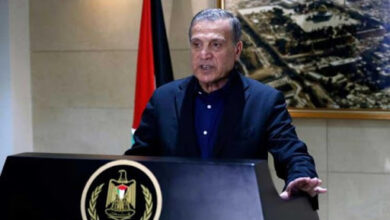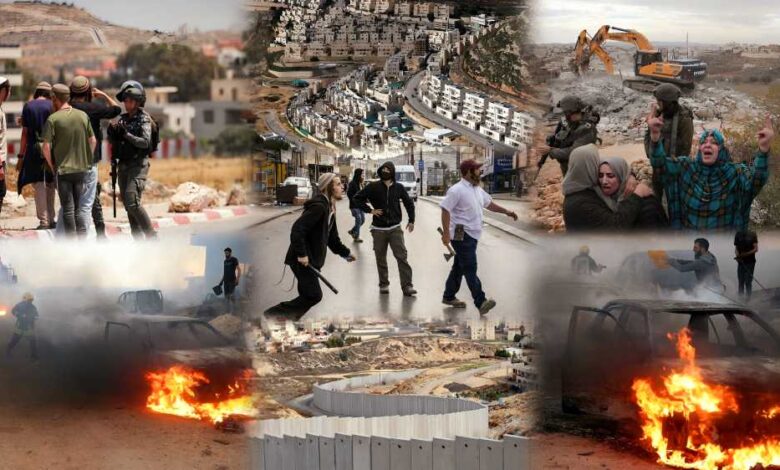
Ramallah (UNA/WAFA) – Minister Mu’ayyad Sha’ban, head of the Commission against the Wall and Settlements, said that Israeli occupation forces and settlers carried out a total of 1872 attacks during the month of January, continuing the systematic terrorism practiced by the occupying state against our Palestinian people, their lands, and their properties..
Shaaban explained in the commission’s monthly report, “Occupation Violations and Colonial Expansion Measures,” that the occupation army carried out 1404 attacks, while the settlers carried out 468 attacks.
He explained that these attacks were mainly concentrated in the Hebron Governorate with 415 attacks, followed by the Ramallah and Al-Bireh Governorate with 374 attacks, then the Nablus Governorate with 328 attacks, and the Jerusalem Governorate with 201 attacks, in a clear indication of the intensity of the systematic targeting of these areas..
He explained that the attacks took many forms, including direct physical violence, uprooting trees, burning fields, preventing farmers from accessing their lands, seizing property, in addition to demolishing homes and agricultural facilities.
He pointed out that these practices are accompanied by the occupation forces closing off large areas of Palestinian land under the pretext of “security,” while providing protection and enabling settlers to expand within it..
He said that the settler attacks, which amounted to 468, in one of the peaks of settler terrorism targeting Palestinian villages and Bedouin communities, were concentrated in the governorates of Hebron (124 attacks), Nablus (123 attacks), and Ramallah (80 attacks), by settlers, which led to the displacement of 125 Palestinian families from 3 Bedouin communities..
He added that settlers carried out 349 acts of vandalism and theft of Palestinian property, affecting vast areas of land. Their attacks, carried out with the help of the occupation army, also resulted in the uprooting, destruction, and poisoning of 1245 olive trees in the governorates of Hebron, Ramallah, and Nablus..
Shaaban stressed that these facts confirm once again that what is happening is not isolated attacks, but rather a systematic policy of forced displacement carried out through the terrorism of the settlers and with the direct protection of the occupying state.
He added that the displacement of families and the destruction of property, land, and trees constitute a compound crime against humanity and the land, and an integral part of a gradual, de facto annexation project managed through intensive terrorism..
He pointed out that settlers have attempted to establish nine new settlement outposts since the beginning of January, mostly agricultural and pastoral in nature. He explained that the recent escalation in attempts to establish these outposts could only have occurred with clear instructions from the political leadership of the occupying state, with the aim of imposing facts on the ground and further fragmenting the Palestinian territory..
Shaaban said that last January the occupation authorities seized 744 dunams of citizens’ land, explaining that the occupation authorities issued two orders to seize land for military purposes in the governorates of Ramallah, Nablus and Jenin, through which they seized 50 dunams, with the aim of building a colonial road west of Ramallah and expanding another security road on the lands of the governorates of Nablus and Jenin.
He added that the occupation seized 694 dunams of land in the Qalqilya and Salfit governorates in order to establish a new settlement called “Dorot” according to the declaration of state lands.
Shaaban stressed that these announcements come at a dangerous political moment, where legislation, structural plans, and confiscation decisions are integrated with colonial tenders to form a comprehensive system aimed at imposing irreversible realities on the ground according to the occupation discourse, and transforming the occupation from a temporary situation into a permanent system of coercive sovereignty..
He pointed out that during November, the occupation authorities carried out 59 demolition operations that affected 126 facilities, including 77 inhabited homes, 6 uninhabited homes, 37 agricultural facilities, and 4 sources of livelihood, concentrated in the governorates of Jerusalem, Hebron, Ramallah, Al-Bireh and Bethlehem.
He explained that the occupation authorities distributed 40 demolition notices targeting Palestinian structures, continuing their campaign of restricting Palestinian construction and the natural growth of Palestinian villages and towns. The notices were concentrated in the governorates of Hebron, Jerusalem, Qalqilya, Bethlehem, Nablus, and Jenin..
He explained that the planning authorities in the occupying state studied a total of 21 structural plans for the benefit of West Bank settlements and within the boundaries of the occupation municipality in Jerusalem during the month under review. He added that the occupation municipality in Jerusalem approved 3 structural plans pertaining to Jerusalem settlements and submitted 6 other plans for subsequent approval, totaling 1266 settlement units, on an area estimated at 120 dunams of Palestinian land..
While the planning authorities of the Civil Administration studied 12 structural plans for West Bank settlements, approving 7 structural plans and depositing 5 other plans for subsequent approval, with the aim of building a total of 1463 settlement units, of which 820 units were approved for construction, and 643 units were deposited for subsequent approval, on an area of 2632 dunams of citizens' land..
Shaaban added that the maps accompanying the structural plans showed the Israeli occupation authorities' approval of establishing a new industrial zone on 788 dunams of Palestinian-owned land in the Tulkarm Governorate. The danger of this new settlement/industrial zone, which the occupation authorities have named "Bustani Hefetz," lies in the fact that it creates a new colonial expansion, adding to the existing "Avnei Hefetz" settlement to the east, extending to the 1967 borders. This further fragments Palestinian territory, blurring the lines in favor of colonial settlements..
(is over)